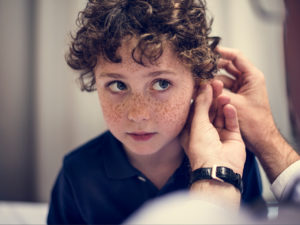


Could Your Child Be Having Trouble Hearing? Signs Parents Shouldn’t Ignore
Children don’t always know how to explain that they aren’t hearing well.
Instead of saying, “I’m having trouble hearing,” a child may turn the television up, misunderstand directions, struggle in the classroom, seem distracted, or repeatedly ask, “What?”
Because hearing plays such an important role in speech, language, learning, and communication, recognizing possible signs of a hearing problem is important.
What Does Hearing Difficulty Look Like in Children?
Hearing difficulties don’t always look the way parents expect.
A child who isn’t consistently responding may appear distracted or inattentive. A child who misunderstands instructions may seem as though they aren’t listening. Another child may compensate so well that the problem isn’t obvious until school becomes more demanding.
Some signs parents may notice include frequently asking people to repeat themselves, turning the television or devices louder than others prefer, not responding when called from another room, watching a person’s face closely while they speak, misunderstanding words or instructions, difficulty following conversations in noisy environments, speaking unusually loudly, complaints that an ear feels clogged or sounds are muffled, changes in classroom performance, or appearing unusually tired after school.
Any one of these signs doesn’t automatically mean a child has hearing loss, but persistent concerns are worth discussing with a professional.
Why Can Hearing Problems Be Hard to Spot?
Hearing isn’t necessarily all or nothing.
A child may hear some sounds perfectly well while having difficulty hearing others. They may also hear well in a quiet bedroom but struggle significantly in a noisy classroom.
Children are also remarkably good at adapting.
They may rely on facial expressions, context, routines, or watching other children to figure out what is happening. Those coping strategies can sometimes make hearing difficulties less obvious to adults.
Hearing and the Classroom
A classroom can be one of the most challenging listening environments for a child.
Teachers move around the room. Other students talk. Chairs scrape across the floor. Heating and cooling systems run. Instructions may be given while children are working on another task.
Even a relatively mild hearing difficulty can make it harder to catch every word.
If a child consistently misses pieces of information, it may affect more than academics. It can also influence confidence, participation, and interactions with classmates.
What About Frequent Ear Infections?
Ear infections and middle ear fluid can sometimes temporarily affect how well a child hears.
Parents may notice that sounds seem muffled or that their child suddenly begins asking for repetition.
If your child has experienced recurring ear problems or you have concerns about how well they are hearing, discussing those concerns with their pediatrician and an audiologist can help determine whether additional evaluation is appropriate.
When Should a Child Have a Hearing Evaluation?
If you, your child’s teacher, or another caregiver has concerns about your child’s hearing, it is worth investigating.
Parents know their children well. If something seems different, whether it’s speech, responses, listening behavior, school performance, or communication, don’t feel that you have to wait for the problem to become more obvious.
A hearing evaluation can provide valuable information about how a child is hearing and whether additional care or monitoring may be needed.
Hearing Is Part of the Whole Family’s Communication
Supporting a child’s hearing isn’t only about test results. It’s about helping them communicate comfortably at home, participate confidently at school, and stay connected with the people around them.
If you have questions about your child’s hearing or aren’t sure whether testing is appropriate, Athens Oconee Audiology can help you determine the best next step for your family.